

One Login, One Bill: Why I Built the Releasy Suite
Releasy Suite
Hookfire tells you the moment something happens, not what to build next. Why I bundled it with Upvoted and Indie Polls for $29.90 a month.
The tabs problem, and the one that came after it
I built Hookfire because I was tired of refreshing Stripe, Sentry, and Vercel in six different tabs. I wanted one simple thing: when something important happens in a tool I already use, ping my phone. No new dashboard. No other SaaS to babysit.
That worked. My phone buzzes when a payment lands, when a deploy breaks, when a customer opens a chat. The six tabs are gone.
Then I ran into the problem that lives directly behind that one.
Knowing something happened is not the same as knowing what to do about it. Hookfire is very good at telling me a customer just churned. It has nothing at all to say about why, or about what I should have shipped three weeks earlier to keep them. Alerts are a record of the past. They are the wrong instrument for deciding the future.
I kept solving that second problem badly. Feature requests arrived by email and sat in a folder. I asked people questions in DMs and lost the answers. I made roadmap calls based on whoever had complained most recently, which is a polite way of saying I was guessing.
So I built the two things I was missing, and I put all three behind one subscription.
The other two
Upvoted is a feature voting board. Your users post what they want, other users vote on it, and the noise sorts itself into a ranked list. You can run boards publicly so your community sees the roadmap, or privately for internal planning. Features move through statuses you define, from proposed to shipped, and people who voted find out when their thing lands. There is an embeddable widget so requests can come from inside your product instead of from your inbox.
Indie Polls is for the questions a vote count cannot answer. You describe what you want to learn, AI drafts the survey, and you embed it on any page or share it as a link. You can target it to specific URLs or paths, so you ask people about onboarding while they are actually onboarding. Results come back in real time.
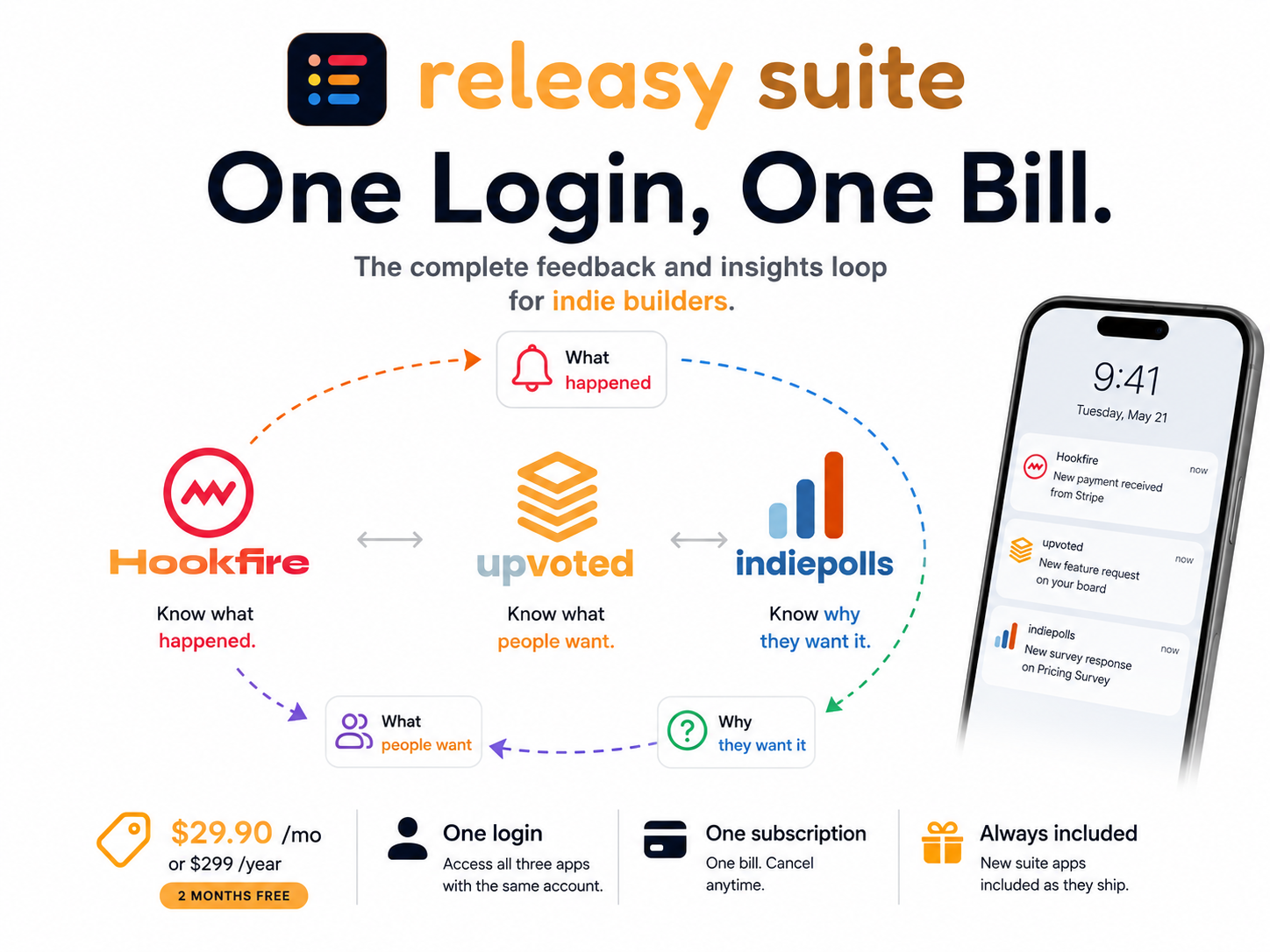
Put next to Hookfire, the shape is obvious in a way it was not when I started:
- Hookfire tells you what happened.
- Upvoted tells you what people want.
- Indie Polls tells you why they want it.
That is the loop I was already living in, badly, across a folder of emails and a spreadsheet.
The part I did not expect
Upvoted and Indie Polls both send webhooks. Hookfire receives webhooks. So they are Hookfire integrations, sitting in the same list as Stripe and GitHub.
Which means the loop closes literally. Someone posts a feature request on your Upvoted board and your phone buzzes. Someone finishes a survey on your pricing page and your phone buzzes. It is the same notification stream that already carries your payments and your errors, so there is no new place to check.
I did not design that on purpose. It fell out of the fact that all three products speak the same protocol, and it is now the part I use most.
Why one subscription instead of three
I could have shipped three products with three checkouts and three logins. I have been on the other end of that, and it is miserable. Three passwords, three invoices, three cancellation flows, three things to forget you are paying for.
So the Releasy Suite is one purchase.
Buy it in any of the three apps and the other two unlock for the same email address, usually within seconds. There is no separate account to create and no second registration. Each app has a switcher in the header, a small grid icon next to your avatar, and clicking through to another product signs you in on the other side.
The switcher is always there, whether or not you have bought anything. I did not want a menu that hides products from you until you pay, because that is just an ad wearing a UI costume.
Two honest caveats, because I would rather you find them here than in a support email.
The first: each product keeps its own account and its own data. There is no shared workspace or shared team roster across all three. Your Upvoted team is your Upvoted team. What crosses the boundary is your identity and your subscription, not your org chart.
The second: you manage the suite subscription in whichever app you bought it in. The other two will link you back there rather than let you buy twice. This is deliberate, but it does mean the billing page you want is not always the app you happen to have open.
What it costs
The Releasy Suite is $29.90 a month, or $299 a year, which works out to two months free.
Each product on its own top tier is $14.90 a month. Three of those is $44.70. So the bundle is cheaper than two of them, and you get the third for less than nothing.
Every plan starts with a 7 day free trial. No credit card. If you decide it is not for you, cancel in a click and nothing happens.
One more thing worth saying plainly: new suite apps are included as they ship. I am one person, so I am not going to promise a release calendar. But if a fourth product shows up, it lands in the same subscription rather than in a new one.
Who this is actually for
The same people Hookfire has always been for. Solo founders, developers, micro SaaS teams, bootstrapped businesses. People who do not have a product manager, a research team, or a growth department, and who therefore have to be all three of those on a Tuesday afternoon between other work.
If that is you, the three tools cover the loop you are already running in your head: ship, listen, decide. You just get to stop running it out of your inbox.
If you are already on Hookfire, open the switcher in your header and have a look at the other two. The trial does not ask for a card, so the worst case is you spend ten minutes and go back to what you were doing.
Steve
 Steve
Steve
Turn your webhooks into phone alerts
Know the instant you make money, ship a deploy, or get a support ticket. Stripe, GitHub, Shopify and 25+ more, all as push notifications.
Releasy Corp, 33024 US Highway 19 North, Palm Harbor, FL. US 34684
© 2026 Releasy Corp. All rights reserved.
Other apps from Releasy

Build a community where users provide feedback, vote, and discuss the product features that truly matter to them. Request features from anywhere with the one line embeddable widget.
Indie friendly lightning fast polling you can embed anywhere or share with one click. Generate polls with AI in seconds, get detailed stats, and configure everything in seconds.

A text RPG of private descents. AI generates a fresh dungeon in real time every playthrough, shaped by your choices and never repeated.